
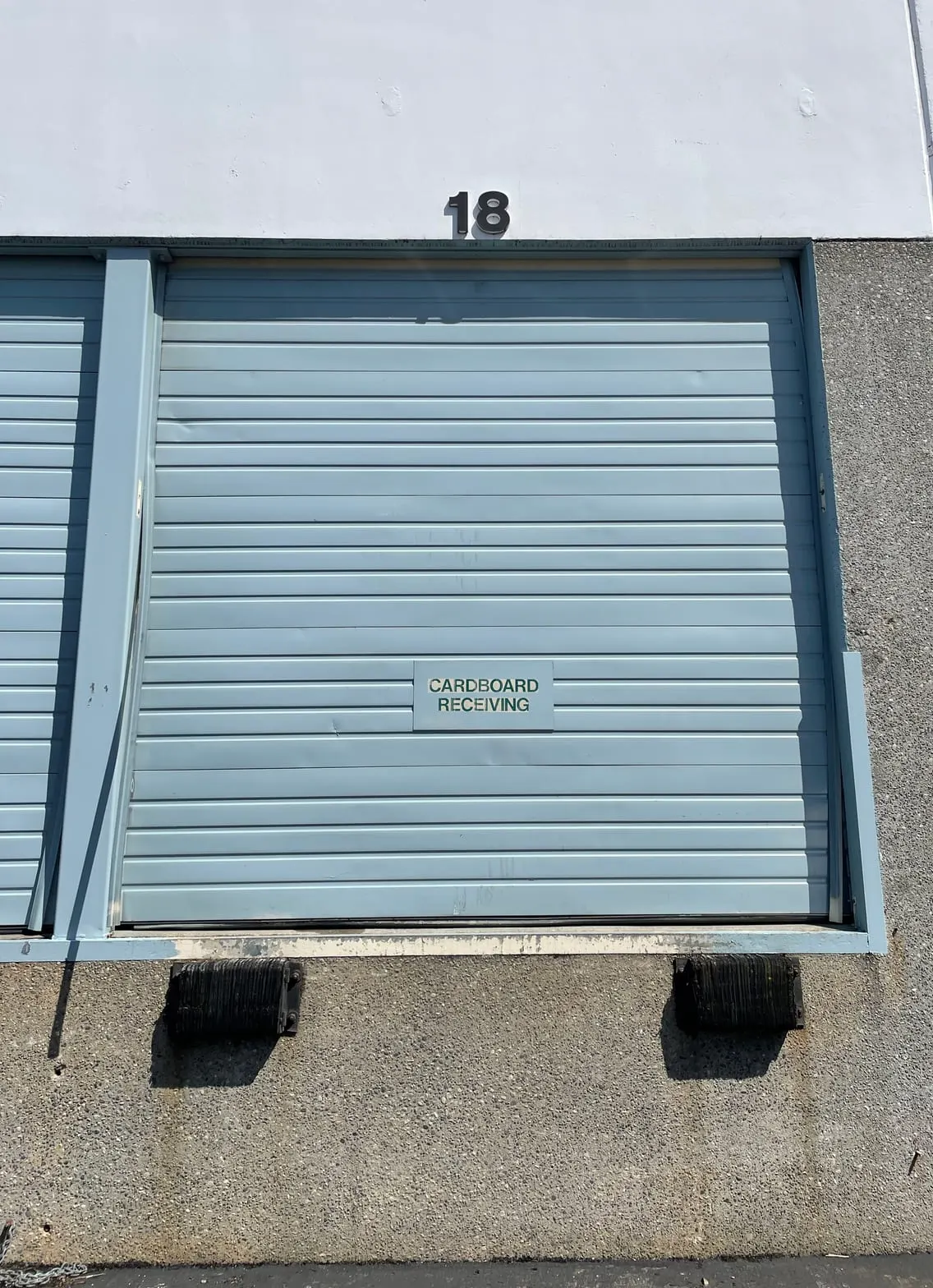
You're standing in the garage watching the door shudder on its way up again, and your spouse says it: "They should just put one of those commercial doors on here. The ones at the shop never break down." It sounds reasonable. It's also not quite right, and settling this one means understanding what actually makes a commercial door different — because it's not just size.
It's Not About Being Bigger, It's About Being Built for Cycles
A residential garage door is engineered for a handful of trips up and down each day — maybe ten to fifteen cycles if your household is busy. A commercial or warehouse door, especially one on a loading dock or a shop with trucks coming and going, might open and close fifty, a hundred, or more times a day. That's the real design difference: commercial doors use heavier-gauge steel, reinforced tracks, and industrial-grade springs and openers rated for continuous duty. The residential door at your house isn't weaker because it's cheaper — it's built for a completely different job.
The Hardware Tells the Story
Open up the mechanics and you'll see it right away. Commercial doors typically run on heavier torsion springs rated for tens of thousands of cycles, thicker steel tracks that won't flex under constant use, and openers with higher horsepower and continuous-duty motors instead of the intermittent-duty motors in most home openers. Many also use different lift systems — high-lift or vertical-lift tracks — to clear ceiling-mounted equipment or give trucks more clearance, something almost no detached garage needs.
Why You Can't Just Bolt One onto a House
Here's where the argument usually ends. A commercial door and its hardware are heavier, which means the garage structure — the header, the framing, the opener mounting points — has to be built to carry that load. Most residential garage framing isn't designed for it. You'd also be paying for capacity you'll never use: industrial door sections and openers cost significantly more than residential ones, often several times the price, and that premium buys cycle life you won't rack up opening the door for the minivan twice a day.
There's also the practical mismatch of insulation and sealing. Homes in this part of Indiana deal with real winter — ice, road salt tracked in on tires, and big temperature swings between a humid summer and a sub-freezing January. Residential doors are designed with weatherstripping and insulation packages aimed at keeping a living space comfortable. Commercial doors prioritize durability and security over thermal performance, since a warehouse bay isn't being heated and cooled like a house.
Maintenance Looks Different Too
Because commercial doors cycle so much more often, they need attention on a tighter schedule:
- Lubrication: Rollers, hinges, and springs on a high-cycle commercial door often need lubrication monthly rather than a couple times a year.
- Spring inspection: With springs rated by cycle count, a busy commercial door can burn through that rating in a year or two and needs regular checks for wear, not just when something breaks.
- Track and roller wear: More cycles mean faster wear on rollers and track alignment, so these need checking more frequently to prevent a door that runs crooked or binds.
- Opener service: Continuous-duty motors still need gear and chain inspections on a set schedule, especially in facilities running the door dozens of times a day.
A residential door, by contrast, holds up fine on an annual or twice-a-year maintenance visit — checking spring tension, lubricating moving parts, testing the auto-reverse safety feature, and making sure winter grime and road salt haven't worked into the tracks and opener.
When a Commercial-Style Door Does Make Sense
There are legitimate cases where a heavier-duty door fits a home: a detached pole barn or workshop used daily for equipment, a farm building, or a garage that doubles as a small business space. If a door is going to see high-cycle use, take real wind load, or needs extra security, it's worth discussing a heavier door and opener pairing designed for that load — not because it looks tougher, but because it's matched to how it'll actually be used.
When to Call Butlerville Garage Door
If you're genuinely running a door hard — a home workshop, a small commercial space, or a barn door that's cycling constantly — it's worth having us take a look before you buy anything. We handle both garage door installation and commercial garage door service for properties around Butlerville and Jennings County, and we can tell you honestly whether your situation calls for upgraded hardware or whether a well-maintained residential door and opener will outlast the argument entirely. If your current door is just struggling under normal household use — sticking, slow to close, noisy in cold weather — that's usually a maintenance or spring issue, not a sign you need an industrial door.
Give Butlerville Garage Door a call if you want a straight answer on what your garage actually needs, residential or otherwise. We serve Butlerville, North Vernon, Vernon, Columbus, Seymour, Greensburg, Batesville, and Scipio, and we'll tell you the truth even if it settles the argument in your spouse's favor.